Plasmid vs. Synthetic DNA: The Honest Comparison

Kate E. Broderick Ph.D
I've been working in DNA-based medicine long enough to have spent most of my career defending plasmid to regulatory bodies, knowing very well it wasn't the perfect starting material. Nobody in the field thought it was. The antibiotic resistance gene was always a challenge that had to be defended. The endotoxin profile was always something you managed. The months-long lead times were absorbed as the fixed cost of doing business. The field used plasmid because it was the only viable option, and structured programs around its limitations rather than its strengths.
In 2026, there is a strong alternative to plasmid. And the field is just waking up to the incredible benefits that come with making that shift.
What Shifted and When
The barriers that kept synthetic DNA from being a real alternative weren't scientific conviction. Nobody was arguing that plasmid was the best option. The barriers were manufacturing scale and cost, because 20 years ago linear or synthetic DNA couldn't be produced at the quantities needed for clinical and commercial programs, and the cost per gram wasn't even close to being competitive. Watching those barriers come down one by one is what shifted my thinking. We're now at a point where synthetic DNA can be produced from research-grade quantities through GMP and commercial scale, priced at parity with plasmid, with manufacturing redundancy in the United States and Europe. The argument for staying on plasmid is no longer based on cost or scale.
The Technical Comparison
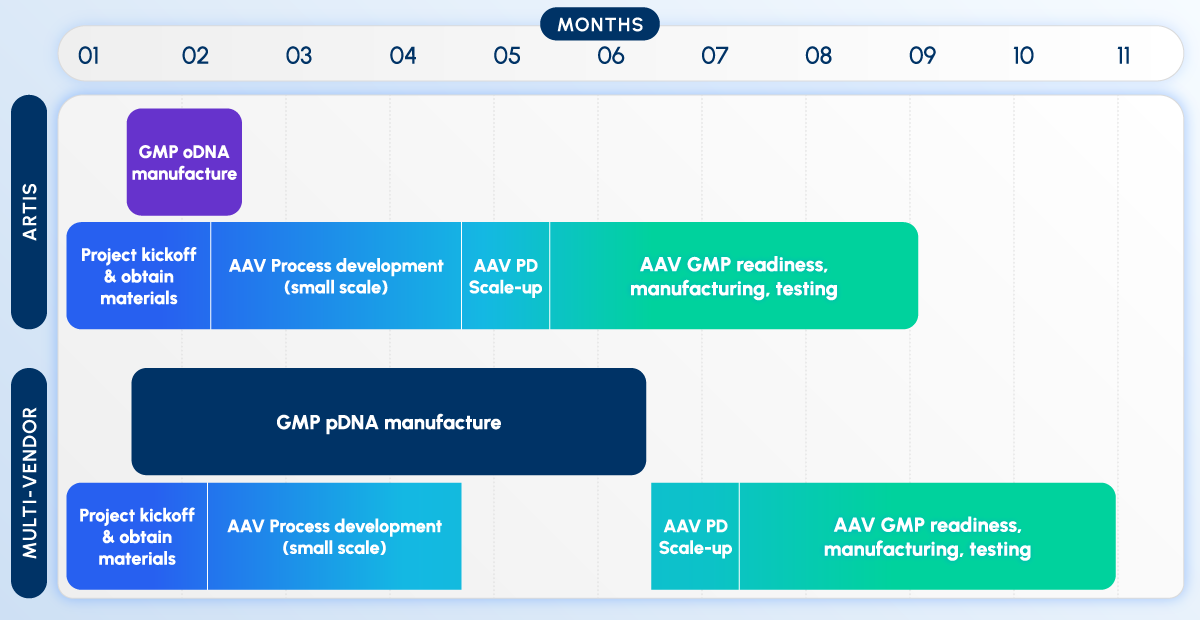
Synthetic DNA removes bacterial fermentation from the production chain entirely. The process is enzymatic rather than biological, which means turnaround time doesn't depend on whether bacteria cooperate with a given sequence. It's sequence-agnostic, and for programs where time is a clinical variable, like personalized cancer treatments, the difference between days and months isn't a supply chain preference. It's built into the efficacy.
Removing bacterial fermentation also removes the antibiotic resistance gene and the endotoxin profile inherent to plasmid production. The regulatory justification is simpler as a result. Regulators who've spent years working through antibiotic resistance gene safety submissions can appreciate that the synthetic DNA profile is considerably more straightforward. Removing those limitations can also assist with regulatory strategies that plasmid-based programs find difficult to fit into, including the ability to argue platform to the FDA rather than bespoke biologic, with the DMF strategy and licensing implications that come with it.
Optional adapter technology adds a functional advantage beyond purity and speed. We can engineer the ends of the synthetic DNA molecule for the specific downstream application, improving polymerase processivity for in vitro transcription or enhancing nuclear translocation for DNA vaccines. The starting material isn't simply plasmid without the challenges. For many applications, it's a better input resulting in improved functionality.
Where Synthetic DNA Fits Across Modalities
The central dogma hasn't changed. DNA flows to RNA flows to protein, and there's no way around that, which means the starting material touches every entity in the biologics ecosystem. As a template for in vitro transcription to make RNA, synthetic DNA is an extremely natural fit because the adapter technology allows us to engineer better polymerase binding sites with meaningfully improved processivity. But the case is equally strong for DNA as an API directly, for AAV and viral vector construction, for CAR-T programs, and for CRISPR. It's genuinely difficult to find a modality in the nucleic acid medicine space where synthetic DNA can't play a meaningful role.
The Supply Picture
The case for synthetic DNA isn't only about what it enables. Major GMP plasmid manufacturers have left the market. Countries without domestic fermentation infrastructure are carrying real strategic exposure from their reliance on a small number of CDMOs. Those countries are treating synthetic DNA as an industrial policy priority now, in many cases moving faster than the United States. For developers still planning around plasmid, the question isn't only whether the alternative is ready. It's whether the infrastructure they're counting on will still be there when they need it.
Honestly, that infrastructure is becoming less and less reliable. Seriously consider acting now and making that shift, not when you are forced to.
About Artis BioSolutions
Artis BioSolutions is an end-to-end, gene-to-GMP platform for genetic medicines, combining cell-free synthetic DNA with process development, analytical development, GMP manufacturing, and IND-enabling CMC support. Our teams in the United States and Europe work as a true extension of your organization at every stage of the program.
If your program depends on DNA starting material, whether as an IVT template, an API, or a component of viral vector, CAR-T, or CRISPR manufacturing, we would welcome the conversation about what synthetic DNA could change for your timeline.
Key Takeaways
The barriers to switching from plasmid were never scientific. Here is what has changed on cost, scale, fidelity, modality fit, and supply.
The shift
The barriers that kept synthetic DNA from being viable were manufacturing scale and cost, not scientific doubts about whether plasmid was the right material. Both barriers have been addressed.
What synthetic DNA removes
Removing bacterial fermentation removes the antibiotic resistance gene, endotoxin concerns, and biological variability in turnaround. The process is sequence-agnostic and can move from sequence to starting material in days.
What it adds
Optional adapter technology allows synthetic DNA to be engineered for the specific downstream application, improving processivity for IVT and nuclear translocation for DNA vaccines.
Fidelity, honestly
Our synthetic process operates at approximately one error per ten million. Sequencing as a release criterion is the standard mitigation.
Modality coverage
Synthetic DNA fits every nucleic acid modality: mRNA via IVT, DNA vaccines, AAV and viral vectors, CAR-T, and CRISPR all require DNA components at some stage.
Cost and scale
Pricing is at parity with plasmid. Manufacturing spans research-grade through commercial GMP with US and European redundancy.
The supply picture
Major plasmid manufacturers have exited the market. Countries without domestic fermentation infrastructure are treating synthetic DNA as an industrial priority and moving faster than the United States.
Frequently Asked Questions
The questions developers ask most often about moving from plasmid to synthetic DNA.
When did the case for synthetic DNA become compelling?
The scientific case was always there. The barriers were manufacturing scale and cost, which kept the option from being practical for most programs. Watching those barriers come down is what changed the conversation. We're now at parity on cost, able to serve programs from research-grade through commercial scale, and the regulatory environment is more favorable than it's ever been. The remaining barrier is the inertia of a field that's structured itself around plasmid for 30 years.
What are developers missing out on when they stay on plasmid?
The misconception isn't that plasmid is good. Nobody thinks that! The misconception is that the barriers to switching are still what they were. They're not. Cost parity has been achieved. Manufacturing scale has been addressed. The regulatory environment is actively favorable to synthetic DNA. What developers are still treating as a future consideration is a present option right now, and the supply picture for plasmid is contracting at exactly the moment that demand for nucleic acid medicines is growing.
How does the plasmid-to-synthetic-DNA question change by modality?
The central dogma hasn't changed, which means synthetic DNA as a starting material is relevant to every modality that requires a DNA component, which is essentially all of them. The most immediate fit is as an IVT template for manufacturing RNA, where adapter engineering can produce measurable improvements in polymerase processivity. But the case is equally strong for AAV and viral vector programs, DNA vaccines, CAR-T, and CRISPR. It's genuinely hard to identify a modality where synthetic DNA can't play a role.
What does the regulatory path look like for programs switching mid-development?
Regulators are welcoming this transition. The antibiotic resistance gene and endotoxin concerns that come with plasmid are removed, and reviewers who've spent years working through those submissions find the synthetic DNA profile considerably less challenging. There is already a Drug Master File on file with the FDA for a synthetic DNA platform. Beyond the simpler review, removing those limitations also allows a developer to argue platform to the FDA rather than bespoke biologic, which has meaningful implications for overall DMF strategy and downstream licensing that are less available to plasmid-based programs.
What is happening to the plasmid supply picture?
It's contracting. Major GMP plasmid manufacturers have left the market. The infrastructure the industry has depended on is shrinking at exactly the moment that demand for nucleic acid medicines is growing. Countries without domestic fermentation infrastructure are treating synthetic DNA as a strategic priority, in many cases moving faster than the United States. The question for any developer still planning around plasmid is not only whether synthetic DNA is good enough. It's whether the plasmid infrastructure they're counting on will be there when they need it.
Where do you think this market is in five years?
Synthetic DNA will have moved from an emerging option to the standard for most programs where speed and purity matter. I don't think plasmid disappears completely; there will likely be applications where it still makes sense. But the direction of travel is clear, and the companies and countries that invest in synthetic DNA infrastructure now, before it's the obvious consensus choice, will have built the manufacturing capability and speed advantage that the rest of the field will be trying to catch up to.
Connect with the Artis BioSolutions team
inquiries@artisbiosolutions.com | artisbiosolutions.com